
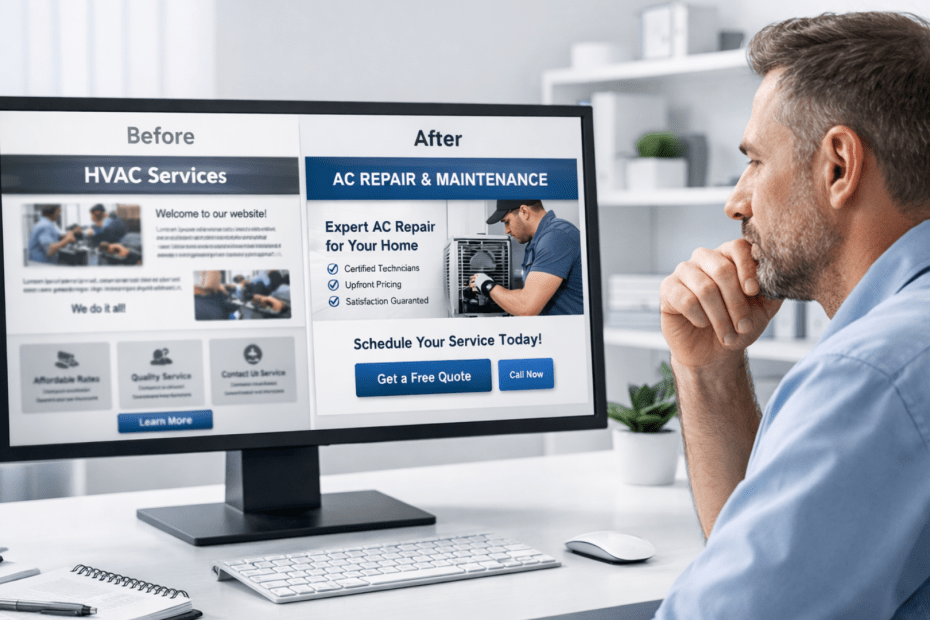
How to Structure HVAC Service Pages for Better Local Visibility, Stronger Trust, and More Booked Calls
If your HVAC service pages are live but still not driving enough visibility or booked calls, the problem usually is not page count.
It is that the pages are trying to do too much, saying too little, or sounding too much like every other contractor page in the market.
Many HVAC sites have service pages that are technically “there,” but still miss two jobs that matter: showing the homeowner they are in the right place and giving them a reason to trust the company enough to take the next step.
That usually shows up in a few familiar ways. One page tries to cover repair, replacement, and maintenance at once. Different service pages reuse the same opening copy with a few keywords swapped out. Proof is buried. The CTA is vague. On mobile, the page feels harder to use than it should.
A strong service page should make the service obvious, reduce doubt quickly, and make the next step easy. In practice, most underperforming pages suffer from one or more of three problems: an intent problem, a trust problem, or a conversion problem.
This article breaks down how to structure HVAC service pages so they are clearer, more useful, and more likely to turn the right search traffic into real leads.

Why HVAC Service Pages Matter More Than Most Companies Think
A service page focuses on one specific service your company provides, such as AC repair, furnace installation, heat pump replacement, ductless mini-split service, or indoor air quality solutions. Each page gives one service its own chance to be understood, trusted, and chosen.
Someone searching for AC repair often has an urgent problem. Someone searching for furnace replacement may be comparing options before making a larger purchase. Someone looking for indoor air quality help may still be trying to understand the issue. When one page tries to cover all of that, it becomes less clear, less relevant, and less persuasive.
These patterns are common, but not rigid. Some repair searches are really replacement decisions in disguise, and some replacement searches come from urgent system failure.
That is where HVAC sites can lose ground. The page exists, but it does not match the search, remove doubt, or make action feel easy.
For a broader look at how service pages fit into the larger search landscape, you can also read Colorado HVAC Marketing in 2026: What Changed, What Still Works, and What Owners Should Do Now.

What Strong HVAC Service Pages Do Differently
A strong service page is not just a place to mention a service and a city. Its job is to move the right visitor from search to confidence to action.
Match What the Homeowner Is Looking For
If someone lands on an AC repair page, it should feel unmistakably about AC repair within a few seconds. Not cooling in general. Not “home comfort solutions.” Not a generic HVAC overview page with a few repair references added in.
The same goes for furnace repair, heat pump installation, or mini-split replacement. The narrower and clearer the page focus, the easier it is for both search engines and homeowners to understand what the page is for.
Broad “Heating and Cooling” pages often underperform for this reason. They try to rank for too many intents while helping the reader with none of them deeply enough.
Build Trust Before the Reader Starts Doubting
Many homeowners landing on a service page are trying to decide quickly whether your company feels credible enough to contact.
Proof should not look the same on every service page. It should match the doubt the homeowner is already feeling.
On a repair page, the biggest questions are often:
-
Can these people actually diagnose the issue?
-
Will they show up quickly?
-
Am I going to get pushed into a replacement I do not need?
On a replacement page, the questions are different:
-
Can I trust this company to recommend the right system?
-
Do they make the buying process easier to understand?
-
Do they offer financing or explain options clearly?
That means the proof should match the service. A repair page may benefit from a review that mentions fast response, clear diagnosis, or honest recommendations. A replacement page may benefit more from financing language, warranty details, or a review that mentions professionalism and a smooth install.
A weak proof block might say, “We are committed to quality service.” A stronger one might say, “The technician explained the issue clearly, fixed it quickly, and never pushed replacement when repair still made sense.”
Proof that speaks directly to the service usually carries more weight because it feels earned, not pasted in. For a deeper look at the role reviews and trust signals play in booked calls, see Colorado HVAC Reputation Management: A No-Fluff System to Win More Calls (Without Spending More on Ads).
Make the Next Step Easy to Take
A repair page may point toward scheduling service. A replacement page may point toward requesting an estimate. A maintenance page may point toward booking a tune-up.
When the next step is vague, the page creates friction. When it is specific, it usually feels easier to act.

How to Build a Strong HVAC Service Page Step by Step
1. Start With a Headline That Makes the Service Obvious
The headline should make the service obvious immediately.
Weak headlines tend to sound polished but unclear:
-
Professional HVAC Services
-
Total Home Comfort Solutions
-
Heating and Cooling Experts
Those headlines do not tell the homeowner what page they are on.
A better headline is direct:
-
AC Repair
-
Furnace Installation
-
Heat Pump Replacement
-
Ductless Mini-Split Service
If local relevance belongs there, add it naturally:
-
AC Repair in Denver
-
Furnace Installation for Homeowners in Colorado Springs
The goal is not to stuff a phrase into the headline. The goal is to remove doubt fast.
Bad: Professional Cooling Solutions for Your Home
Better: AC Repair for Homeowners in Denver
2. Open With the Service Problem, Not a Generic Company Intro
Right below the headline, the page should answer two questions quickly:
-
What is this service?
-
Who is this page for?
In many cases, one short section is enough.
A weak intro talks about the company in general terms. A stronger intro talks about the service problem.
For example, an AC repair page can mention warm air, weak airflow, strange noises, frozen coils, or a unit struggling during peak summer heat. That is usually more useful than a generic paragraph about your commitment to comfort.
3. Put Trust Signals Where People Will Actually See Them
A common service-page mistake is delaying proof.
A homeowner should see signs of credibility early. That may include:
-
recent review snippets
-
star ratings
-
years in business
-
licensed and insured language
-
emergency availability
-
financing options
-
warranties or guarantees
-
manufacturer certifications
You do not need every trust signal on every page. You do need enough to help the company feel established and reliable. The exact proof will depend on what your business can honestly support.

4. Explain the Service in a Way Homeowners Can Understand
After the opening and proof, explain what the service involves, when it makes sense, and what the homeowner should expect next.
This is where many HVAC pages become less effective. A lot of pages describe the service in broad, polished language but never help the reader decide whether they even need it.
For example, a furnace installation page should not just say that your company installs high-efficiency systems. It should help the reader understand when replacement makes sense, what happens during the estimate, whether the old system is removed, and what install day looks like.
A maintenance page should explain what the tune-up includes, what kinds of issues it can catch early, and why routine service matters before peak heating or cooling season.
Plain language does not just mean simpler words. It means fewer vague claims and more useful explanation.
5. Show the Real Problems the Service Solves
A strong service page helps the reader recognize their own situation.
An AC repair page might address:
-
warm air coming from vents
-
poor airflow
-
short cycling
-
unusual noises
-
water leaks
-
frozen components
A furnace replacement page might address:
-
rising repair frequency
-
uneven heating
-
higher utility bills
-
aging equipment
-
safety concerns
-
a system that can no longer keep up
This section works best when it describes the problem the way a homeowner experiences it. “The house is still warm after the AC has been running for hours” is often more relatable than purely technical wording.
6. Back Up the Page With Specific Proof
“Add proof” is good advice, but only when the proof is concrete enough to matter.
Useful proof can include:
-
a review tied to that service
-
a short customer example
-
photos of the team or work
-
a process overview that builds confidence
-
equipment experience
-
warranty or workmanship language
-
financing information when relevant
Want your HVAC company to show up in more searches like this?
We do a free marketing audit, no pitch call required. Email us your website and service area and we'll tell you exactly where the gaps are.
Get Your Free Audit →
Specific proof is usually more persuasive than generic claims. “Highly trained technicians” is easy to say. A short service-specific review or a clear process section is easier to believe.
7. Use a CTA That Fits the Service and Situation
The CTA should fit the reason the person came to the page.
A repair page may call for Schedule Service.
A replacement page may call for Request an Estimate.
A maintenance page may call for Book a Tune-Up.
A lot of pages still use weak or generic CTAs.
Bad: Contact Us
Better: Schedule AC Repair
The stronger version reduces friction because it matches the task already in the homeowner’s mind. Some pages may also need a secondary path, especially when the homeowner is not ready for the same action every time.

8. Use Internal Links to Support the Page
A service page should not feel isolated from the rest of the site.
It can naturally link to:
-
related services
-
financing pages
-
maintenance plans
-
contact pages
-
review or reputation content
-
location pages when relevant
That improves navigation for users and makes the site structure clearer for search engines. The goal is not to cram in links. It is to connect the page to the next questions a homeowner is likely to have.
For example, a service page article like this one can reasonably link to broader search strategy content such as Colorado HVAC Marketing in 2026: What Changed, What Still Works, and What Owners Should Do Now, to trust-focused content like Colorado HVAC Reputation Management: A No-Fluff System to Win More Calls (Without Spending More on Ads), and to creative/visual guidance like AI Graphic Design for Colorado HVAC Marketing: How to Create Better Ads, Pages, and Promotions Faster.
Example Block: What a Better AC Repair Page Looks Like
Editorial note: This section should be visually distinct in the live layout so it reads like a practical example block, not just another body section.
Here is a hypothetical AC repair page structure example. Replace every proof point below with claims your business can verify.
Headline
AC Repair in Denver for Homeowners Who Need Fast, Reliable Cooling Help
Opening Section
When your AC starts blowing warm air, short cycling, freezing up, or struggling to keep your home cool, delaying service can sometimes make the problem harder to solve. Our team helps Denver homeowners diagnose AC issues and understand the next step so the system can get back to running safely and reliably.
Trust Block
-
Strong local review profile
-
Licensed and insured HVAC technicians
-
Emergency service available
-
Financing options available for larger repair decisions
Problems Solved Section
We help homeowners with common AC problems such as:
-
warm air from vents
-
low airflow
-
frozen evaporator coils
-
unusual noises
-
leaking water
-
systems that stop keeping up during peak summer heat
Why Choose Your Company
We inspect the system, explain what is happening in plain language, and help you understand whether the next step is repair, further testing, or replacement.
CTA
Schedule AC Repair
That example is not fancy. Many HVAC service pages do not need cleverer writing. They need clearer structure, stronger proof, and a more useful path to action.

The Most Common HVAC Service Page Mistakes
Writing Copy That Sounds Like Every Other Contractor
If the copy could be pasted onto almost any HVAC site without sounding out of place, it is too generic.
This often shows up in opening paragraphs about quality service, customer satisfaction, or home comfort that say nothing specific about the service itself. It also shows up in “why choose us” sections that rely on broad claims instead of anything a homeowner can actually use to judge credibility.
Making Different Service Pages Say the Same Thing
A lot of HVAC companies have separate service pages, but the pages do not always do separate jobs.
The AC repair page opens with the same paragraph as the furnace replacement page. The heat pump page uses the same proof block as the mini-split page. The CTA stays the same no matter what service the homeowner came in looking for.
That is not a strong service-page system. That is one template wearing different labels.
Shared structure is fine. Shared messaging is where the problem starts. Each page should earn its place by addressing a distinct service need and a distinct next step.
Treating Keywords Like the Whole Job
Keyword targeting matters. But a service page does not earn calls just because it mentions the right phrase.
It has to match the service clearly, reduce doubt fast, and make the action feel easy.
That is where many pages fall short. They are written as if ranking is the only job. Even if the page gets found, it still has to survive comparison. Homeowners may open multiple contractor sites in separate tabs. If your page sounds broad, vague, or interchangeable, being visible may not be enough.
Hiding or Weakening the CTA
A lot of HVAC pages lose momentum right before the point of action.
Sometimes the CTA is too generic. Sometimes it shows up too late. Sometimes it does not match the service at all.
If someone lands on a furnace replacement page, “Contact Us” is weaker than “Request a Furnace Estimate.” If someone is on an AC repair page, the next step should feel immediate and relevant to the problem they are trying to solve.
A Quick HVAC Service Page Audit
Before publishing or revising a page, ask:
-
Is this page clearly focused on one service?
-
Would a homeowner know within a few seconds that this page matches the problem they have?
-
Is there proof near the top that fits the kind of decision this service requires?
-
Does the page explain when this service makes sense, or does it only describe it in broad terms?
-
Does it describe the problem the way a homeowner experiences it, not just the way a contractor would label it?
-
Is there a real reason to trust this page over two other HVAC companies a homeowner might open in nearby tabs?
-
Is the CTA specific to the service and easy to find on a phone?
-
Does the page link naturally to related content that helps the reader take the next step?
-
If you removed the company name, would there be anything in the page that still feels distinct?
That last question matters. A service page does not need to be brilliant. But it should hold up well in comparison. If a homeowner opens three contractor pages in separate tabs, yours should not read like the same page with different branding.

How to Tell if a Service Page Is Doing Its Job
A page may be too weak if:
-
it gets traffic, but very few calls or form submissions tied to that service
-
people land on it, but the page still feels broad or interchangeable
-
the CTA does not match the service or buying stage
-
the page gets visits, but the leads feel vague or poorly qualified
-
the proof is generic, buried, or disconnected from the service itself
A stronger page can start to help in more practical ways:
-
more visits from people actually looking for that exact service
-
more calls or form submissions tied to that page’s topic
-
clearer differences between how repair pages perform versus replacement pages
-
better lead quality because the page does a better job of setting the right expectation
-
stronger support for nearby pages through internal linking and clearer site structure
Sometimes the first sign of improvement is simpler than a ranking jump. The calls become more specific. The form submissions make more sense. The page starts attracting people who are asking for the exact service it was built around.
That is often a sign the page is doing its real job better: matching the right search, qualifying the visitor, and making action easier. Page structure matters, but it is not the only variable. Weak reviews, poor follow-up, weak offers, or thin local authority can still limit results.
Final Thoughts
A lot of HVAC companies already have service pages. What they often do not have is service pages built to do the job well.
A strong page should make the service obvious, build trust quickly, and make the next step easy. That is what helps the page do more than sit on the site.
When the structure is clear, the proof feels believable, and the CTA fits the service, the page becomes more useful for both search visibility and conversion.
Need a Clearer Way to Review Your Current Service Pages?
If your current service pages are live but underperforming, the goal usually is not to rewrite every page from scratch.
The better first step is to figure out which pages are too broad, which ones are too thin to build trust, and which ones are close enough that a few structural changes could improve performance.
In practice, that often means finding pages that:
-
try to target too many services at once
-
reuse the same copy across repair, replacement, and maintenance pages
-
hide proof too far down the page
-
use a CTA that does not match the service or buying stage
-
get traffic, but do not turn that traffic into the right kind of calls
That kind of review is a better starting point than making isolated edits without a clear diagnosis. It helps you see which pages have an intent problem, which ones have a trust problem, and which ones have a conversion problem.
If you want a more focused next step, start by reviewing the 3 to 5 service pages that matter most to your lead flow. Look for which ones have the clearest intent problem, the weakest trust signals, or the biggest conversion friction first.
If you want a second set of eyes, reach out for a focused service-page review. A good review should show you which pages are too broad, too thin, or too generic, and which few changes are most likely to improve visibility, trust, and qualified calls before you spend time rewriting everything.

Need Help Building a Better HVAC Marketing System?
Most HVAC companies do not need more service pages, they need properly structured service pages.
At Core Values Marketing, we help HVAC companies tighten the parts of digital marketing that actually influence booked calls: stronger trust signals, cleaner service-page messaging, better local visibility, sharper ad creative, and more consistent lead-generation systems.
If your marketing feels active but disconnected, AI alone will not solve that.
A better system will.
Want help creating a cleaner, more credible marketing presence for your HVAC company? Contact Core Values Marketing at contact@corevaluesmarketing.com or call 720-295-8438 to talk through your current setup and where the biggest improvements may be.