
How Google Works for HVAC Companies: LSAs, Map Pack, and Organic Search
If you run an HVAC company, you have probably asked some version of this question: Why are other companies getting calls from Google when we seem to show up too?
That is the right question.
In many HVAC markets, the answer is not as simple as rankings alone. Google often shows a mix of Local Services Ads, the Map Pack, and organic service pages for the same search. Google says local results are mainly based on relevance, distance, and prominence, while Local Services Ads are built to generate leads through calls, messages, and bookings for eligible service categories. (support.google.com)
That matters because HVAC searches can be time-sensitive. Someone looking for AC repair on a hot day or furnace service during a cold stretch is usually not comparing brands the way a marketer would. They are scanning for who looks relevant, who looks trustworthy, and who feels easiest to contact right now.
This article breaks down what a homeowner actually sees when they search for HVAC help, how Google decides who shows up, and where visibility tends to turn into calls or leak them.
Why “Ranking Higher” Is Too Simple for HVAC Owners
A lot of marketing advice treats Google like a ladder: move up a few spots, get more traffic, get more calls.
For HVAC, that framing is too narrow.
A better question is this: what does a homeowner actually see when they search for one of your services, and what are they most likely to choose first?
That broader view matters because a company can appear somewhere on Google and still lose the lead. You might have a decent organic page but weak local proof. You might have a strong profile but shallow service pages. You might show up well in one city and weakly in the next.
That is why HVAC owners should think about the SERP as a local decision environment, not just an SEO report. That same idea also connects naturally to Colorado HVAC Marketing in 2026: What Changed, What Still Works, and What Owners Should Do Now.
Why HVAC searches are different from slower local searches
Some local searches are casual. HVAC searches often are not.
If someone is comparing painters or researching landscaping options, they may browse for a while. If their AC stops working in July or their furnace goes down during a cold stretch, the search tends to be more urgent.
In HVAC, the homeowner is usually trying to answer a few questions fast:
- Can this company help with the exact issue?
- Do they seem nearby?
- Do they look credible?
- Can I contact them right now?
That makes trust signals, service match, review profile, and click-to-call convenience more important than many owners realize.
What winning on Google actually looks like
Winning the SERP does not always mean being first in one place.
More often, it means showing up well across the parts of Google that matter most:
- LSAs help capture urgent, call-ready demand.
- The Map Pack helps validate local trust and relevance.
- Organic service pages help confirm fit and support conversion after the click.
If one of those assets is weak, the rest often have to work harder.
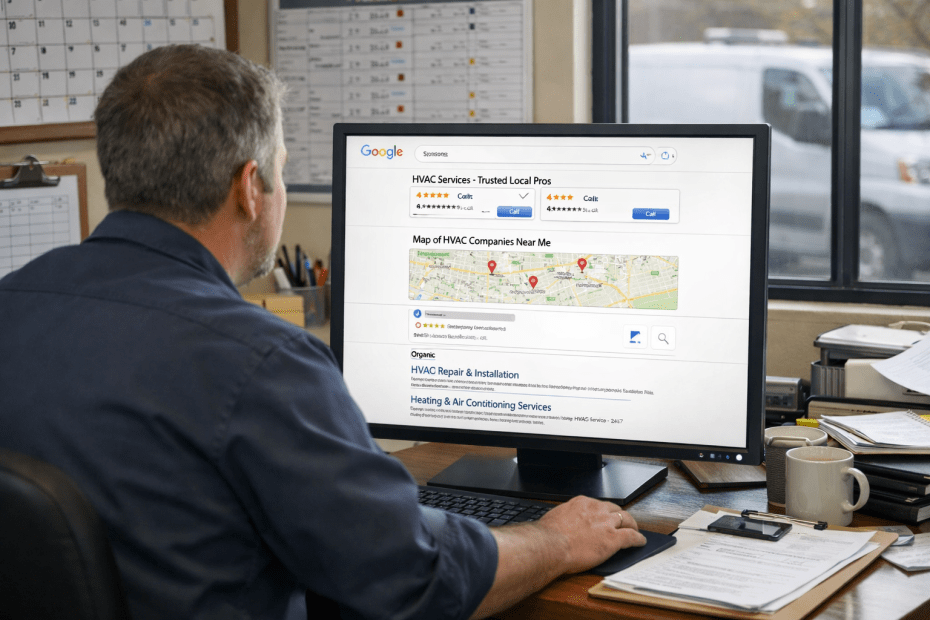
What a Homeowner Actually Sees When They Search for HVAC Help
For many HVAC searches, the results page is not one simple ranking list.
It is usually a mix of paid, local, and organic visibility. Ahrefs describes local search as a combination of local pack results and traditional “blue link” results, while Semrush describes the Local Pack as a distinct SERP feature that tends to appear for location-specific, commercial-intent queries. Search Engine Land similarly defines the Google Local Pack as a small set of local business listings that typically appears above organic results when Google sees local intent. (ahrefs.com)
Take a search like “AC repair Denver.” In a competitive market, a homeowner may first see LSAs, then a local pack, then organic service pages. That exact mix can vary by market, device, and query, but it is a useful model because each layer tends to do a different job. Paid units can grab urgent attention. The Map Pack can validate local trust. Organic pages can confirm whether the company feels like the right fit. (support.google.com)

Local Services Ads (LSAs)
Local Services Ads are one of the most important paid placements for HVAC because they are built around direct lead capture, not just impressions. Google says LSAs can show services offered, service area, hours, reviews, photos, a phone number, and a business profile preview, and can let customers call or message directly from the ad. (support.google.com)
For an HVAC owner, that means LSAs are often strongest at capturing demand from people who already know they need help and are ready to contact someone quickly.
If competitors dominate this part of the page and your company is absent, you may be losing attention before the homeowner even gets to the local listings or organic results. That is also where your Ad Management work fits into the bigger picture. Paid visibility is not the whole system, but in many HVAC markets it is part of the real search environment homeowners are choosing from.
The Google Map Pack
The Google Map Pack is the local-results section tied to a map. Search Engine Land describes it as a featured set of local business listings for local-intent searches. Semrush notes that it can appear above or below ads depending on the query, and Ahrefs notes that it helps searchers compare hours, contact information, ratings, and distance quickly. (searchengineland.com)
For HVAC companies, this is often one of the fastest comparison points on the page. Homeowners scan ratings, review count, business names, and whether the company looks like a believable local option.
This is also the section many owners mean when they say, “We want to rank on Google Maps.” That is exactly why a well-built Google Business Profile matters so much. Google says complete and accurate Business Profile information makes a business more likely to show up in local search and helps customers know what the business does, where it is, and when it is open. (support.google.com)
Organic service pages and local landing pages
Organic results still matter, especially for HVAC.
A strong service page can do what a short ad or listing cannot do on its own. It can explain the service clearly, mirror the exact problem the homeowner is trying to solve, show proof, and make the next step feel easier.
For example, a furnace repair page should not read like a general company overview. It should make clear what problems it covers, what the homeowner can expect, and how to request service.
That is why organic visibility should not be treated as separate from local visibility. Ahrefs notes that local SEO involves both Local Pack visibility and standard organic results, and that a homepage is unlikely to rank for every service keyword, which is why separate service pages are often needed. (ahrefs.com)
This is also where broader SEO for HVAC companies starts to show up in a practical way, and where weak HVAC service pages can quietly hurt performance after you earn the click.
What Google Uses to Decide Who Shows Up
For local results, the clearest framework is still relevance, distance, and prominence.
Google says there is no way to request or pay for better local ranking in local results, and that local results are mainly based on relevance, distance, and prominence. Google also recommends keeping business information complete and accurate because that helps the profile show up for relevant searches. (support.google.com)
Relevance
For HVAC companies, relevance is about match.
Does your profile clearly reflect what you actually do? Are your categories accurate? Are your services aligned with the searches you want to appear for? Do your service pages clearly match real homeowner searches like AC repair, furnace replacement, or heat pump installation?
A vague profile and vague site create weak relevance.
There is a big difference between a company that clearly signals furnace repair, AC installation, and mini split replacement versus one that just says it handles “heating and cooling solutions.”
Distance
Distance is the factor many owners underestimate because they cannot fully control it.
Google defines distance as how far a business is from the customer who is searching. If the customer does not share their location, Google uses what it knows about that searcher’s location. Search Engine Land also notes that local pack results are highly customized to the location of the searcher, which is why the same business may look stronger in one part of town than another. (support.google.com)
That matters for HVAC because service areas are often wider than true visibility areas. An owner may say, “We serve the whole metro,” but Google does not treat every part of that metro equally.
If your company serves multiple cities, uneven visibility is normal. The goal is not perfect coverage everywhere. The goal is to strengthen relevance and prominence where the right searches happen most.
Prominence
Prominence is where proof and reputation start doing real work.
Google says prominence reflects how well-known a business is and notes that more reviews, better ratings, and links from other sites can help local visibility. NP Digital’s January 2025 local-pack ranking-factor study reported that proximity was the strongest observed factor, followed by review volume and rating, with behavioral signals like clicks and direction requests also mattering. (support.google.com)
For HVAC companies, prominence shows up in practical ways: a stronger review profile, more visible customer activity, and a more established-looking presence across the web.
That is one reason some average operators can outperform better technical companies in search: they may simply look more established online. That is also why Colorado HVAC Reputation Management matters as part of the larger visibility system.

Why One HVAC Company Gets the Call While Another Gets Ignored
Appearing on the SERP and earning the click are not the same thing.
Two HVAC companies can both be visible and still get very different outcomes because the homeowner is making a fast judgment call.
Reviews and trust signals
In many HVAC searches, the homeowner is scanning for one thing first: who feels safest to call?
That decision happens quickly. Review volume, review recency, response behavior, and the overall completeness of your presence all shape trust.
That does not mean every company needs a perfect rating. It means your business needs enough visible proof to reduce doubt. NP Digital’s local-pack study also found that behavioral signals like clicks and direction requests mattered more than keywords alone, which reinforces how much click confidence matters in local search. (neilpatel.com)
Clear service match
If someone searches for furnace repair and your presence feels generic, you are making the homeowner work too hard.
Clarity matters more than many owners think. A company that looks obviously relevant to the exact search often wins over one that feels broad but less specific.
That is true in your profile, in your paid messaging, and on your service pages. It is also true when the homeowner is choosing between repair, replacement, and emergency service. If your company looks ambiguous while another company clearly signals “24/7 emergency repair,” the clearer option often gets the call.
A quick example of how the click gets won
Imagine two HVAC companies showing up for the same search.
One has recent reviews, clearly lists emergency repair, shows “open now,” and lands on a page that immediately confirms the service. The other looks broader, has thinner proof, and sends the click to a generic homepage.
Want your HVAC company to show up in more searches like this?
We do a free marketing audit, no pitch call required. Email us your website and service area and we'll tell you exactly where the gaps are.
Get Your Free Audit →Both may technically be visible. Only one feels like the safer next step.
That is usually how lead flow gets decided on Google: not by one ranking alone, but by how clearly the business looks like the right answer in the moment.

HVAC-specific details that shape the decision
For HVAC, a few details often carry more weight than owners expect:
- Emergency availability: If the homeowner needs help now, “open now” and after-hours relevance matter.
- Financing visibility: For installs and replacements, visible financing options can reduce hesitation.
- Repair vs. replacement clarity: If the homeowner thinks they need a repair, a company that looks install-heavy can lose the click.
- Service-area fit: If the profile or page does not feel local to the searcher’s city, trust drops fast.
Those are not abstract marketing details. They are part of how homeowners decide.
Mobile visibility, hours, and ease of contact
Most homeowners are not running a deep audit of your company.
They are checking whether you are open, whether you seem credible, whether the service looks relevant, and whether they can contact you without friction.
That is why small details like updated hours, visible phone actions, and a page that gets to the point quickly can have an outsized effect on calls. Google specifically recommends keeping business info complete and up to date so customers know what you do, where you are, and when they can reach you. (support.google.com)
Where HVAC Calls Are Usually Won and Lost on the Results Page
Most articles explain each visibility channel in isolation. That misses the point.
The better question is what each part of the SERP is actually best at and where owners often lose ground in each one.
Where LSAs win
LSAs are often strongest at capturing urgent demand quickly.
They are built for people who want to contact a provider now. If your competitors dominate this part of the page and your company is absent, you may be missing call-ready demand before the searcher compares anyone else.
This is also one place companies often lose because the setup is weak: the wrong service areas, thin profile details, or limited ad coverage. Google says service areas and job types affect which searches can trigger your ads. (support.google.com)
Where the Map Pack wins
The Map Pack is often strongest at local proof and quick comparison.
This is where the homeowner validates who looks nearby, established, and credible enough to contact. It is often the fastest trust screen on the page.
This is also one place companies often lose because reviews are thin, profile details are incomplete, or the listing does not feel local enough to the searcher.
Where organic results win
Organic results are often strongest at depth and confirmation.
This is where your company can explain what the service includes, who it is for, what to expect, and why the homeowner should feel comfortable taking the next step.
This is also one place companies often lose because the page is too generic, too broad, or too slow to reassure the visitor after the click.
A simple way to think about the HVAC SERP
A simple way to remember it:
- LSAs = speed
- Map Pack = trust
- Organic = depth
It is not a perfect rule for every market, but it is a useful working model.
If you are weak in all three, visibility is probably the problem.
If you are strong in one and weak in two, inconsistency is probably the problem.
If you show in all three and still underperform, the issue is often conversion clarity, service match, or post-click confidence.

A Quick HVAC Visibility Audit You Can Use Right Now
This is the part most HVAC owners can use immediately.
Instead of treating the article like theory, use it as a working diagnostic. Ahrefs frames local search as a combination of Local Pack and organic visibility, while Semrush emphasizes that Local Pack performance is tied to profile quality, reviews, accurate business information, and supporting local signals. (ahrefs.com)
Score Your HVAC SERP Presence from 0 to 12
Give yourself one point for each “yes.”
Check your Local Services Ads visibility
- Are you active in LSAs for your highest-value services?
- Are your service areas aligned with the searches you actually want?
- If a homeowner compares your ad to the two around it, do you look like one of the best options?
Google says Local Services ads highlight services offered, service area, hours, and reviews, the same elements customers use to make a quick choice. (support.google.com)
Check your Google Business Profile and Map Pack strength
- Is your primary category aligned with your core revenue service?
- Do you have recent reviews that sound like real HVAC jobs, not vague praise?
- Are your hours, phone number, services, and profile details complete and accurate?
A weak profile usually does more damage than owners think. That is part of why a stronger Google Business Profile setup matters so much in local search.
Check your service pages
- Do your top services each have their own page?
- Do those pages clearly match service-specific and city-specific intent?
- Do those pages build trust quickly with proof, clarity, and a strong next step?
This is often where broader SEO for HVAC companies shows up in a practical way. If the site does not clearly support service intent, location intent, and next-step clarity, organic visibility becomes harder to trust and harder to convert. It is also where weak HVAC service pages can quietly hurt performance after you earn the click.
Check the mobile experience
- Can someone understand what you do in the first few seconds?
- Is it obvious how to call or request service?
- Does your presence feel more credible than the companies around you?
What your score actually means
0 to 4: You likely have major visibility gaps.
5 to 8: You are showing up in places, but probably leaking calls.
9 to 12: You have a solid foundation. The next gains will likely come from prioritization and refinement.
The value of this audit is that it shifts the question from “Are we ranking?” to “Are we actually competitive where homeowners are choosing?”

Three Visibility Mistakes HVAC Owners Make on Google
Thinking Google is one ranking
This is probably the most common mistake.
Owners say, “We rank on Google,” but what that often means is they appear somewhere in the mix. That is not the same as owning meaningful visibility across the full page.
Leaning too hard on one channel
Some companies lean too heavily on paid. Others expect the profile to do everything. Others invest in organic pages but ignore local proof.
That usually creates instability. When one asset softens, lead flow can drop quickly because the rest of the system was never strong enough to support it.
Missing service and city intent
HVAC searches are not interchangeable.
“AC repair near me,” “furnace replacement,” and “mini split installation in Denver” are not asking for the same thing. A generic presence tends to underperform across all of them because it does not look like the right answer to any one search.
What to Fix First If Google Visibility Isn’t Turning Into Calls
Most HVAC companies do not need to fix everything at once. They need to fix the biggest leakage points first.
Fix trust first
If reviews are weak, outdated, thin, or poorly managed, start there.
That does not mean chasing vanity metrics. It means building a profile that looks active, credible, and relevant to the work you actually do.
If that is the weak point, Colorado HVAC Reputation Management is the most natural next read.
Fix service-page clarity next
Once trust signals are stronger, improve the pages that support your organic visibility and post-click confidence.
Your service pages should not feel interchangeable. They should make the service obvious, reduce doubt quickly, and make the next step easy.
That same discipline is part of the larger SEO for HVAC companies picture on your site. Strong local SEO is not just about being found. It is also about being chosen.
Use paid visibility where it helps
If your local SERP is heavily influenced by LSAs and your competitors are active there, paid visibility may need to be part of the system.
That does not mean becoming dependent on paid forever. It means understanding when paid fills an urgent visibility gap and when local and organic assets should carry more of the load.
If that is the missing piece, your Ad Management page is the most natural next step.
Final Thought: More HVAC Calls Usually Come From a Better Search System
The main lesson here is simple: HVAC lead flow from Google is often a systems issue, not just a single-ranking issue.
A homeowner may see your ad, your profile, and your site in the same search journey. If those assets support each other, your company has a better chance of earning the call. If they feel disconnected, generic, or incomplete, visibility can look better than results actually are.
That is why stronger HVAC marketing on Google usually comes from tightening the full path from search to contact, not from chasing one isolated metric.
A practical next step is to review your top services one by one and compare what a homeowner sees before and after the click. If you want help doing that, book a discovery call and we can look at how your company shows up across LSAs, the Map Pack, and your service pages, then identify where visibility is helping and where it may be costing you calls.

Need Help Building a Better HVAC Marketing System?
At Core Values Marketing, we help HVAC companies tighten the parts of digital marketing that actually influence booked calls: stronger trust signals, cleaner service-page messaging, better local visibility, sharper ad creative, and more consistent lead-generation systems.
If your marketing feels active but disconnected, AI alone will not solve that.
A better system will.
Want help creating a cleaner, more credible marketing presence for your HVAC company? Contact Core Values Marketing at contact@corevaluesmarketing.com or call 720-295-8438 to talk through your current setup and where the biggest improvements may be.
Want more calls from
"Found you on Google"?
Tell us your market and service area. We'll give you a plain-English breakdown of where your marketing is leaking, and what the fastest fix is.