
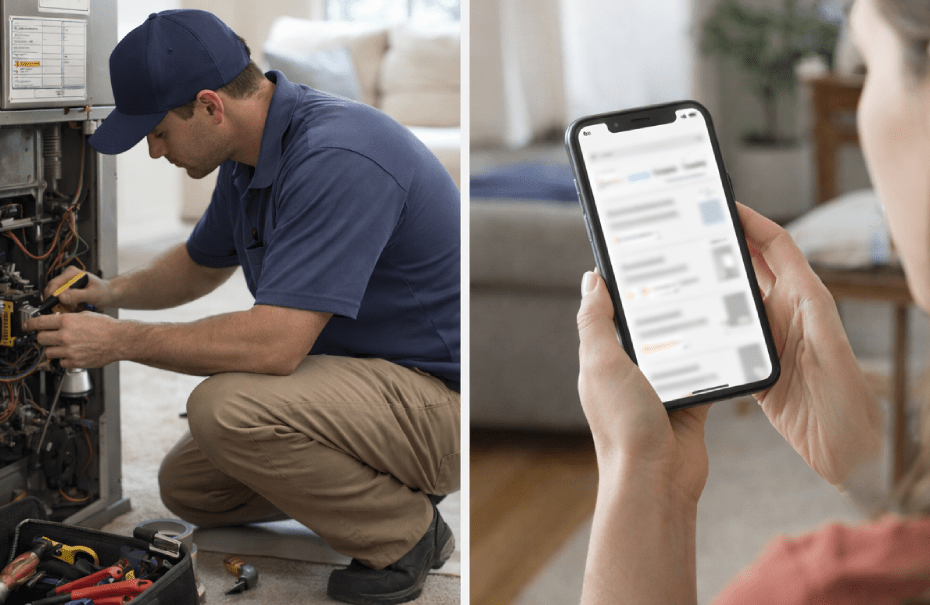
Why HVAC leads go cold before you can call them back. What Did the Homeowner Do While You Were on the Job?
You were on a job. Your phone rang and you couldn’t get to it. You called back when you wrapped up, maybe an hour later, maybe two.
The homeowner was polite. Said they’d already sorted it out. You thanked them, hung up, and moved on.
That happens a dozen times a month for most HVAC companies. You file it under “bad timing.”
But here’s what was happening on their end while you finished up.
They didn’t wait. They didn’t leave a voicemail. Within about four minutes of submitting your form, they were back on Google, still holding their phone, still in the problem. The Map Pack showed three other options. The second result had “Open now” in the listing. They tapped the number, got a live answer, and booked a 4pm window.
At 3:52pm, you call back. She picks up, sounds a little distracted, tells you she already found someone. You say no problem and hang up.
You didn’t lose that job on price. You didn’t lose it on reputation. You lost it in the gap between when they reached out and when you reached back and that gap is shorter than almost any field-based HVAC business can cover without a system built to close it.

What the homeowner is doing on their phone while you finish the job
Most HVAC content focuses on what happens on your end, your response time, your follow-up rate, your system. This section is about what’s happening on the other side of the form submission, because that’s the part most owners have never seen.
After submitting your contact form, the homeowner doesn’t close the browser. They wait roughly 45 seconds, then reopen it. Google shows them a mix of Local Services Ads, the Map Pack, and organic results — and the second Map Pack result has a tap-to-call button and “Open 24 hours.” They don’t read the reviews. They call.
They’re not being disloyal. They’re still in active problem-solving mode and you’ve given them no signal that the problem is being handled.
Speed gets you in the door. What happens in that first conversation is still on you. But you can’t have a conversation you never got to start.
Emergency repair vs. planned replacement: why the response window is different for each
Not all leads move at the same speed, and treating them identically is one of the most common and costly mistakes in HVAC lead handling.
In peak summer heat, an AC that quit at 2pm has a window of minutes, not hours. The homeowner is still on their phone, still in buying mode, and the first company to signal they have it under control gets the conversation. That company usually gets the job.
A homeowner thinking about replacing their 15-year-old system this fall has a window of hours to days. There’s no emergency driving the next decision. They’re comparing options, reading reviews, maybe waiting for a spouse to weigh in.
Build your response system around the emergency case, the 5-minute target and you’re automatically competitive for the planned case too. The reverse doesn’t work. A same-day callback system is adequate for replacements and fatal for emergency repair.
This matters most for cold inbound leads, the homeowner who found you on Google, filled out a form, or saw your Local Services Ad. Referrals and repeat customers already trust you. The response dynamic is different there.

HVAC lead response time: what the data actually shows and why most companies are too slow
InsideSales research tracking over a million sales leads found that your odds of reaching a prospect drop 80 percent after five minutes. Wait 30 minutes and you’re 100 times less likely to connect than you were at minute one. [1]
That research wasn’t done on HVAC leads, it was done on B2B software and financial services contacts. HVAC emergency leads move faster. The relevant benchmark for residential home services comes from Podium, which analyzed response and booking data from 11,000 home service businesses: companies responding within five minutes were four times more likely to close the job. [2]
Only 3 percent of HVAC companies respond in under a minute, according to Hatch’s analysis of HVAC speed-to-lead campaigns. The most common response time is between a few hours and a full day. That’s not a competitive disadvantage for the slow companies, it’s a structural opening that stays open because almost no one has built a system to close it. [3]
Sources: InsideSales Lead Response Management study · Podium via ACHR News · Hatch HVAC Speed to Lead report
Why a same-day HVAC callback loses most emergency repair leads
Most owners who lose leads this way don’t think of themselves as slow. They think of themselves as responsive, because by any reasonable social standard, calling back within a few hours is perfectly fine.
The issue isn’t etiquette. It’s that the homeowner’s consideration window closes before “reasonable” arrives. Harvard Business Review research on lead response rates found that companies responding within the first hour are seven times more likely to qualify the lead than those waiting longer. At 24 hours, it’s 60 times less likely. By same-day standards, you’re already competing from behind. [4]
Source: Harvard Business Review, ‘The Short Life of Online Sales Leads’ (Oldroyd et al.)

Three moments your HVAC lead goes cold and none of them are your fault
Lead loss in HVAC doesn’t happen at one point in the process. It happens at three. Each one is fixable. The problem is that most companies haven’t identified which one they actually have.
Failure point 1: the form that sat in an inbox overnight
It’s 6:48pm on a Friday. An AC repair request lands in the company’s general contact email. The office manager is home. The owner is finishing a job. The email sits there, not because anyone dropped the ball, but because there was never a system for who owns that inbox after 5pm.
The homeowner booked someone else by 7:15pm.
This is the most common failure point for companies that are otherwise well-run. The lead capture works. The after-hours response system doesn’t exist. If your contact form and service pages aren’t set up to route and flag submissions immediately, you’re relying on someone checking email and that’s a gap that opens every evening and all weekend.
Failure point 2: the callback that felt complete
You called. You got voicemail. You left a message. In your head, you did your part.
What you didn’t know: the homeowner was standing in their kitchen when your number came up. They didn’t recognize it. They let it ring. They’re not avoiding you, they just don’t know who you are yet, because they never got the text that would have told them to expect your call.
The fix isn’t calling twice. It’s sending a text before or alongside the call: “Hi, this is Jordan at Mesa Cooling, calling about your AC request, I’ll try you in a few minutes.” That text creates name recognition. The next call gets answered.
Failure point 3: the silence after the first attempt
You tried once. They didn’t answer. You moved on.
Hatch’s analysis of over 130,000 HVAC speed-to-lead campaigns found that the top-performing follow-up sequences used seven touchpoints over five days, a mix of texts and calls across different times of day. Most HVAC companies use a single attempt, then stop. [3]
Want your HVAC company to show up in more searches like this?
We do a free marketing audit, no pitch call required. Email us your website and service area and we'll tell you exactly where the gaps are.
Get Your Free Audit →One attempt is not a follow-up system. For cold inbound leads, the stranger who found you on Google, it’s barely a start.
Lead health check, answer these 6 questions honestly
If you answer No to 3 or more, your follow-up system has a meaningful gap.
- Do web form submissions get seen within 5 minutes during business hours? YES / NO
- Is there a system for after-hours and weekend form submissions? YES / NO
- Does a voicemail trigger an automatic text follow-up? YES / NO
- Does your team attempt contact more than once if the first call goes unanswered? YES / NO
- Do you know your current median response time across a normal week? YES / NO
- Have you calculated what a missed lead costs your business in a year? YES / NO
The structural reason HVAC companies can’t respond fast enough and why discipline won’t fix it
You’re three hours into a diagnostic on a 15-year-old package unit. The homeowner is standing behind you asking questions. You’ve got refrigerant on your hands. Your phone has buzzed four times. The specific job doesn’t matter, you were doing what customers pay you for while a new one was trying to reach you.
You’re not ignoring leads. You’re doing the job those leads are paying for.
This is a physics problem, not a discipline problem. HVAC is a field-based business. The windows when leads arrive most frequently, generally late afternoon on weekdays, and weekend mornings, are exactly the windows when owners are least available to respond. No amount of intention closes that gap. Only a system that operates independently of whether you’re available can close it.
In practice, the companies converting the most inbound leads aren’t the ones personally fastest to the phone, they’re the ones who built something that responds whether they’re on a job or not.

How much an unanswered HVAC lead actually costs: run the numbers yourself
Take a 5-tech HVAC operation doing around $1.2M a year. Average ticket across repair and replacement: $2,600, adjust this for your own numbers. Conservative estimate of cold or missed leads: three per week.
3 missed leads/week × $2,600 × 52 weeks = $405,600/year in unconverted inquiries.
At a conservative 30 percent close rate on recovered leads, that’s $121,000 in additional revenue from the same marketing spend. Not from better ads. From answering faster.
Run it for your own numbers. Most owners who do this math say the result came out bigger than they expected. That’s usually the moment the follow-up system stops feeling like a nice-to-have.
That number doesn’t require more marketing spend to recover. It requires a system that operates in the gap where you currently can’t. If you are spending on paid ads or Local Services Ads and conversion feels lower than it should, this gap is almost always where the revenue is leaking before it reaches you.
What a working HVAC lead follow-up system actually looks like
A working system can be as simple as an after-hours answering service or as complete as an automated text-and-call sequence. Both are better than a form submission sitting in an unmonitored inbox. Here’s what the complete version looks like.
The first 90 seconds: what to send and why it works
Within 90 seconds of a form submission, the homeowner’s phone gets a text:
“Hi [Name], this is Jordan at Mesa Cooling. Got your request. Someone will call you in the next 10 minutes. If it’s urgent, call us directly: [number].”
Thirty words. It does three things: confirms the message landed, gives her a timeline so she stops searching, and offers a direct number if she can’t wait.
In practice, most homeowners don’t call the direct number, the text is enough to pause the active search. They know someone has it. The text doesn’t need to book the job. It needs to halt the next Google search.
The sender name matters too. “Jordan at Mesa Cooling” makes the next phone call expected. When an unknown number rings 8 minutes later, the homeowner picks up because they’re waiting for it.
This also helps your reviews work harder. When a homeowner is still on their phone after submitting your form, they’re often checking your Google profile and reading your reviews while they wait. A fast acknowledgment text means they’re still on your page, not your competitor’s, when they see that 4.9-star rating.
From automated text to booked job: the human handoff
The text creates a window. The call closes it.
For emergency repair leads, the call attempt should happen within ten minutes of the text. For planned replacement inquiries, within two hours is still competitive. The text has already introduced you, the homeowner knows who’s calling before the phone rings.
If they don’t answer, a second text follows: “Tried to reach you, here’s a direct booking link if it’s easier: [link].” That’s not chasing. That’s a system working as designed.
The companies with the best lead conversion rates aren’t those where the owner answers every call personally. They’re the ones who built a follow-up system integrated into their booking funnel that works on their behalf at 6:48pm on a Friday.

The same lead, two different outcomes
Here’s the simplest version of everything this article covers.
You’re not losing leads because your marketing is broken. You’re losing them in the gap between the moment they reach out and the moment you reach back, a window that’s shorter than any field-based business can reliably cover without a system built specifically for it.
That’s not a criticism. It’s a structural problem that happens to every HVAC company growing faster than its follow-up process can keep up with.
Think back to that Friday afternoon. Company A finishes the job, calls back at 3:52pm, and hears “we already found someone.” Company B’s automated text arrived at 2:49pm, 47 seconds after the form submission. The owner called at 2:58pm. The homeowner picked up because she was expecting the call. The job was booked before Company A’s technician had packed up his tools.
Same lead. Same Friday. The only difference was what happened in the nine minutes after she hit submit.
The question worth asking before next week: do you know how long that gap is right now? Not your best day, your median response time, across a normal week, including evenings and weekends. Most owners don’t know. When they find out, the number changes what they do next.
Find out where your leads are slipping
In a funnel review, we map your current lead-to-response timeline, identify which of the three failure points is costing you most, and give you a prioritised action list, usually the three highest-impact changes you can make to your follow-up process. If your setup is already tight, we’ll tell you that too.
corevaluesmarketing.com/funnel-design | contact@corevaluesmarketing.com | 720-295-8438
Citations
- InsideSales.com, Lead Response Management Study. B2B and B2C lead response time analysis, 1.25M leads.
- Podium via ACHR News, “Quickness Key in Managing HVAC Leads”. 11,000 home service business dataset.
- Hatch, “HVAC Speed to Lead Response Rates” (2024). 132,000+ HVAC speed-to-lead campaign analysis.
- Harvard Business Review, “The Short Life of Online Sales Leads” (Oldroyd et al., 2011). Lead qualification rate by response time.
Want more calls from
"Found you on Google"?
Tell us your market and service area. We'll give you a plain-English breakdown of where your marketing is leaking, and what the fastest fix is.